Tenant and deal access
Use role and deal grants, tenant isolation, audit history and permission rechecks before external side effects or file delivery.

For technology and data leaders
Configure each organization's sources, destinations, access and AI policy in one governed operating model. Rainmaker connects data engineering to the real estate decisions it supports.
The challenge
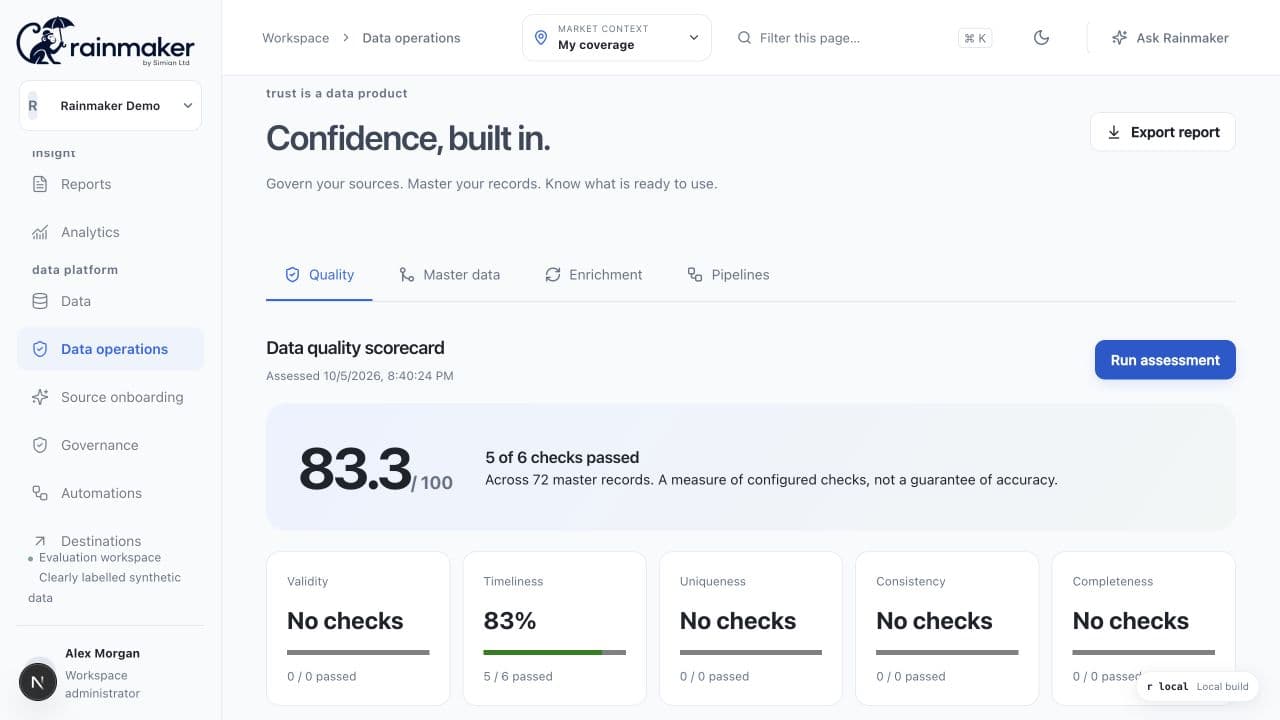
A building can appear under several IDs, with competing owner claims, different dates and rights that restrict downstream use. Rainmaker treats connection setup, capture, mapping, identity resolution, review and publication as distinct steps, so a convenient integration cannot bypass governance.
A governed data path
A new provider export arrives with unfamiliar fields and dated ownership records. The target workflow turns it into usable intelligence without treating an AI-suggested mapping as publication authority.
Configure the customer's entitlement, credentials, allowed scope, rights, refresh cadence and spend limits for each supported source or destination.
Profile the schema, preview transformations and sample failures, and approve versioned canonical mappings and quality rules before publication.
Match buildings, parcels and entities; review ambiguous ownership and occupancy observations; retain competing dated claims and reversible steward decisions.
Carry lineage, rights and currentness into search, APIs, exports, BigQuery and customer destinations. Reconcile jobs and withdrawals across dependent surfaces.
Built for your decisions
Controls apply to the screen, assistant action, API call, background job and destination delivery that touch the same business record.
Use role and deal grants, tenant isolation, audit history and permission rechecks before external side effects or file delivery.
Manage source and destination contracts, mappings, capture and publication cursors, retries, recovery and lineage as inspectable configurations.
Set per-function models, provider-matched tenant BYOK, budgets, evaluations and human authority. Revoked or exhausted tenant keys cannot fall back to platform billing.
Every business capability uses a versioned domain API and finite named MCP operation with the same authorization, validation, idempotency and audit behavior.
Connected to the next move
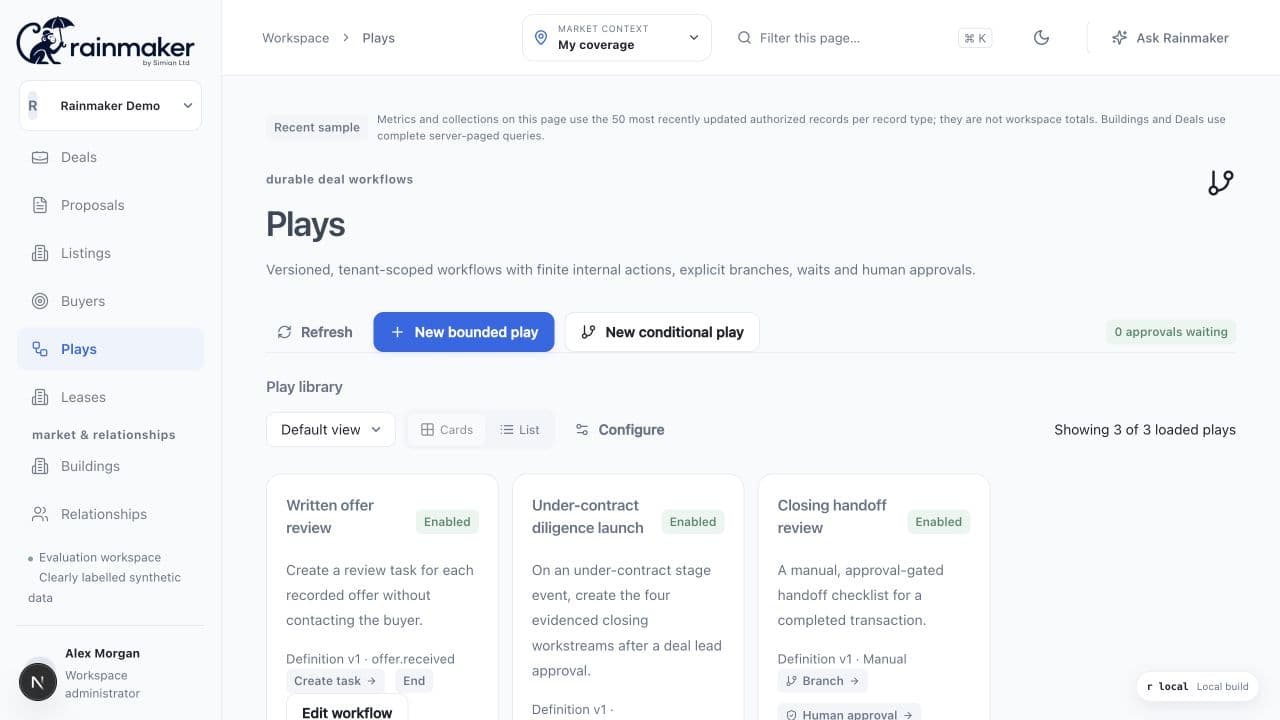
Versioned Plays can prepare broker work, route approvals and wait for events. Leaders can see outcomes and exceptions while tenant administrators control terminology, branding, navigation and who may act.
Good questions, clear answers
Connections are configured for each organization and require a supported adapter, the customer's entitlement, credentials, permissions and data-readiness review. A configured source is not automatically a proven live integration.
The product design applies customer and deal access across the domain API, database, retrieval, jobs and file delivery, with audit and permission rechecks. Specific security or compliance certifications should be assessed from current evidence, not assumed from the architecture.
No separate assistant write path is intended. UI and finite MCP actions use the same versioned domain API, authorization, validation, idempotency and audit requirements.
Let's talk
Tell us which sources, destinations and access rules matter. We can map a customer-specific setup and the evidence needed to accept it.